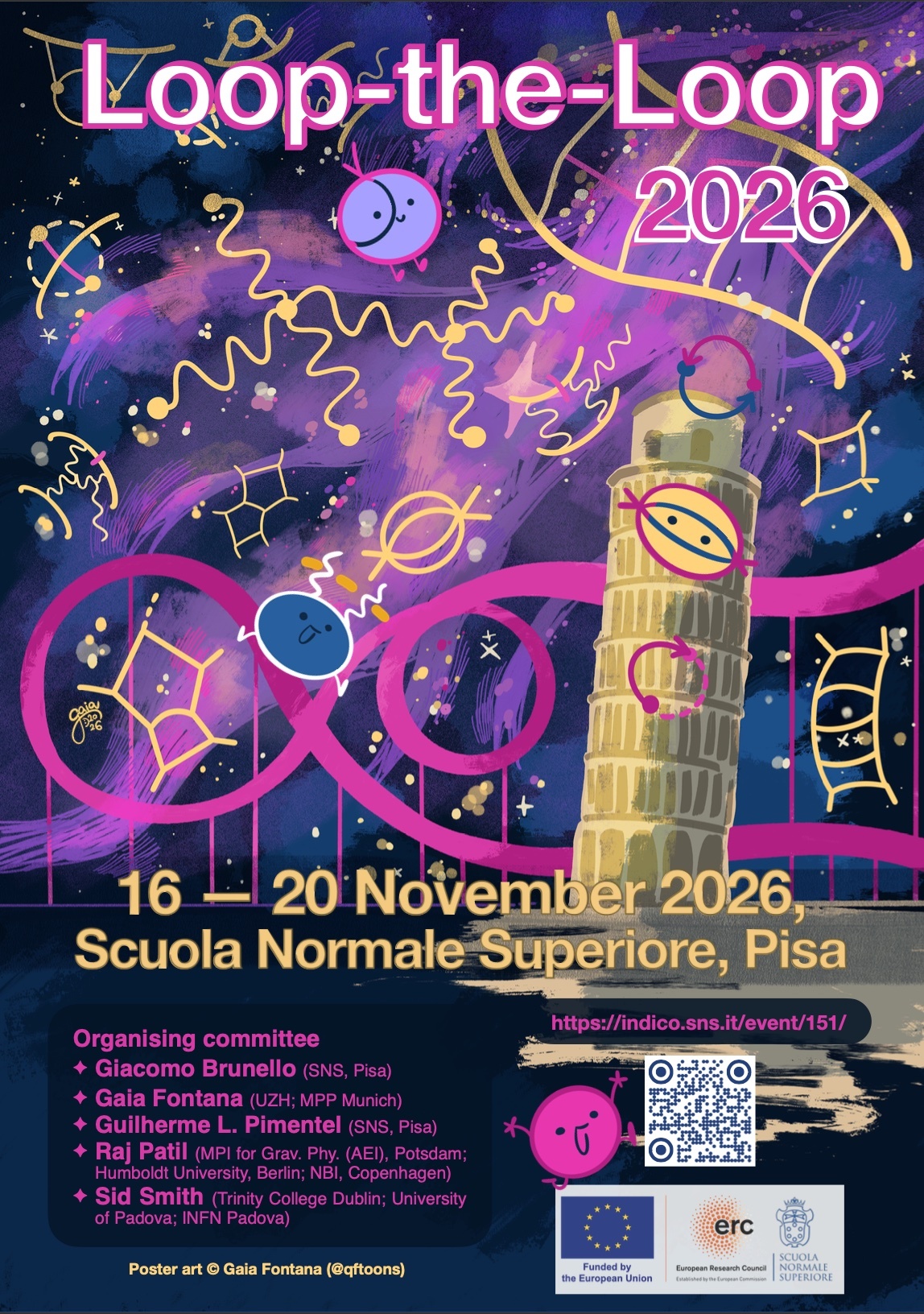
Loop-the-Loop 2026

→ Europe/Rome
Aula Dini

Aula Dini

Palazzo del Castelletto, via del Castelletto 11, 56126 Pisa PI
Description

“Loop-the-Loop: Feynman Calculus and its Applications to Gravity and Particle Physics” returns for its third edition, and for the first time it will be an in-person conference at Scuola Normale Superiore, Pisa, Italy, on 16-20 November 2026. This year we expand to five days, consisting of a two-day school followed by a three-day workshop. The event aims to spark in-depth discussions and strengthen connections across complementary perspectives in the study of scattering amplitudes.

The school during the first two days will consist of three lecture series, curated by field-leading specialists:

  • Asymptotic Expansions in Multi-Loop Calculations
  • Worldline Quantum Field Theory for Post-Minkowskian Gravity
  • Cosmological Correlators

The following three day workshop will be centred around the three topics:

  • Applied Mathematics for Feynman Calculus and Particle Physics
  • Amplitude Methods for Gravitational Wave Physics
  • Cosmological Correlators

These will include review seminars by leading experts in their respective fields. 

Virtual Attendance:

For those who are unable to attend in-person, we also offer the usual virtual format. We will display the Zoom details here.

In-Person Funding:

There is no conference fee for this event, and participants are expected to arrange funding through their own resources. We have a limited amount of funding available to support accommodation for those who are unable to cover themselves. If you are in such a situation then feel free to contact the organisers and we will do our best to help, however priority will be given to speakers.

Organising Committee:

  • Giacomo Brunello (Scuola Normale Superiore, Pisa)
  • Gaia Fontana (University of Zurich; MPP, Munich)
  • Raj Patil (Max Planck Institute for Gravitational Physics, Potsdam; Humboldt-Universität zu Berlin; Niels Bohr Institute, University of Copenhagen)
  • Guilherme L. Pimentel (Scuola Normale Superiore, Pisa)
  • Sid Smith (Trinity College Dublin; University of Padova; University of Edinburgh; INFN Padova)


Local scientific advisors:

  • Carlos Duaso Pueyo (Scuola Normale Superiore, Pisa)


Past Loop-the-loop events:

Sponsors:

This event is hosted by Scuola Normale Superiore (SNS) with the support of the ERC grant 101126304, "NOTIMEFORCOSMO".


 

Registration
In-person participation
Virtual participation
Participants
    • Welcome
    • Worldline QFT for post-Minkowskian gravity: Lecture 1
      Convener: Gustav Jakobsen
    • Coffee break - Conference picture
    • Asymptotic expansions in multi-loop calculations: Lecture 1
      Convener: Kay Schonwald
    • Lunch
    • Worldline QFT for post-Minkowskian gravity: Lecture 2
      Convener: Gustav Jakobsen
    • Coffee break - Conference picture
    • Asymptotic expansions in multi-loop calculations: Lecture 2
      Convener: Kay Schonwald
    • Worldline QFT for post-Minkowskian gravity: Lecture 3
      Convener: Gustav Jakobsen
    • Coffee break - Conference picture
    • Cosmological Correlators: Lecture 1
      Convener: Scott Melville
    • Asymptotic expansions in multi-loop calculations: Lecture 3
      Convener: Kay Schonwald
    • Lunch
    • Cosmological correlators: Lecture 2
      Convener: Scott Melville
    • Coffee break - Conference picture
    • Cosmological correlators: Lecture 3
      Convener: Scott Melville
    • Welcome (Conference)
    • Review: Amplitude methods for gravitational-wave physics
      Convener: Jan Steinhoff
    • Coffee break - Conference picture
    • Direct-to-Symbol Integration from Landau Analysis

      Integrals involving non-integer powers of rational functions appear in a variety of mathematical and physical contexts, from generalised hypergeometric functions to Feynman integrals in dimensional regularisation. When expanded around a fixed value of the twist parameter, such integrals can evaluate to multiple polylogarithms order by order. In this talk, I will present a strategy for computing the symbol of these functions at any order in the expansion directly from the integral's geometry. I will show how to track and classify the ways that an integral can be modified when analytically continued around one of its branch points, and how to use this data to recursively construct its symbol. I will make this explicit in an algorithm for integrals over hyperplane arrangements that can be used to compute the transcendental integrands of cosmological correlators in conformally coupled theories.

      Convener: Craig Larkin
    • HP-Quadrature for Feynman Integrals

      In this talk, I will present a numerical quadrature algorithm for evaluating Feynman integrals in the Loop-Tree Duality (LTD) representation. I will outline the main idea behind the algorithm and explain why the LTD representation is well suited for its application. Finally, I will present proof-of-concept results for one-loop Feynman integrals in the Euclidean region, both at leading and higher orders in the dimensional regulator epsilon as well as for divergent integrals after introducing suitable numerators to render the integrals finite.

      Convener: Cathrin Semper
    • Lunch
    • Analytical 1SF shockwave waveform to all PM orders

      Strong-field effects in General Relativity may be extracted by resummation of weak-field Post-Minkowskian series. Scattering of a small black hole in an infinitely boosted Schwarzschild background, known as a shockwave, is a promising setting to explore such resummations.

      In this talk we consider the waveform emitted from such a system to first order in self-force. Using the recently developed WQFT-based Response Theory, the waveform is computed to all Post-Minkowskian orders. At each order it involves Lauricella hypergeometrics, expanded in dim-reg to Multiple Polylogarithms. We explicitly present the waveform at a few leading PM orders and compare it against a fully PM-resummed numerical computation. Salient properties of the all-PM-order waveform are then discussed, before finally giving a perspective on complete resummation of the PM series.

      Convener: Jitze Hoogeveen
    • TBA
      Convener: Mattia Capuano
    • Coffee break - Conference picture
    • Gong show
    • Conference dinner
    • Review: Cosmological Correlators
      Convener: Enrico Pajer
    • Coffee break - Conference picture
    • Non-factorisable electroweak corrections at two-loop order

      The high-precision physics programmes of current and future colliders call for accurate theoretical predictions that include a realistic modelling of unstable particles such as the W and Z bosons or the top quark. This requires two-loop corrections to high-multiplicity, multi-scale amplitudes, whose exact computation is often beyond the reach of current techniques. The Pole Approximation (PA) offers a powerful way around this: by exploiting the resonant structure of the amplitude, it separates higher-order corrections into two gauge-invariant classes, factorisable and non-factorisable contributions. The latter arise from soft gauge-boson exchanges between the production and decay subprocesses and display a universal structure. In this talk, we will discuss the two-loop electroweak non-factorisable corrections to neutral- and charged-current single-resonance processes. We will then consider the first steps towards extending this framework to double-resonance processes such as top-quark pair, W-pair and Z-pair production, where soft exchanges connecting the two resonances introduce new structures.

      Convener: Fazila Ahmadova
    • NNLO QCD corrections to t\bar{t}W production in the leading-colour approximation

      In this talk, I will discuss the calculation of NNLO QCD corrections for the production of a top-antitop quark pair in association with a W boson at the LHC. The two-loop scattering amplitudes entering the double-virtual contribution are calculated in the leading-colour limit without any kinematic approximation, retaining the exact dependence on the masses of the top quark and the W boson. The calculation involves a high degree of algebraic complexity and non-trivial analytic structures in the underlying Feynman integrals, including nested square roots and elliptic integrals.
      In order to address such difficulties we employ an hybrid approach. We express the amplitude in terms of a set of special functions, which we evaluate numerically by solving the associated system of differential equations, while the rational coefficients of the special functions are computed numerically through finite fields techniques. Finally, the corresponding two-loop hard function are evaluated on a grid of phase-space points in order to obtain the NNLO QCD cross section through interpolation.

      Convener: Matteo Becchetti
    • Lunch
    • Six loops and correlation functions: static gravity to 7PN order

      The computation of higher order post-Newtonian (PN) corrections is fundamental to improving the precision of theoretical predictions for the dynamics and gravitational waves of compact binary systems.
      The static sector of general relativity involves the highest loop integral contributions to the potential at a fixed PN order.

      This talk presents recent results for the static gravitational potential at 6PN and 7PN, obtained within the effective field theory framework.
      We first discuss the computation of the complete 6PN static potential, highlighting the multi-loop techniques that enabled the evaluation of six-loop Feynman diagrams.

      Next we introduce a correlation function framework for the computation of static two-body interactions.
      This approach demonstrates that the static PN factorization theorem follows from the accidental $\mathbb{Z}_2$ symmetry of the static gravitational bulk theory, allowing the determination of odd-PN static contributions directly from lower order results. Within this framework, we derive a closed all order formula encoding the structure of static PN corrections, using it to determine the complete 7PN static potential.
      The same result is further evaluated within a complementary diagrammatic calculation, which exploits the factorization of static contributions.

      These results provide theoretical input for more accurate measurements with future gravitational wave observatories, while offering a new perspective on the classical two-body problem.

      Based on arXiv:2512.19498 and arXiv:2604.14134.

      Convener: Matteo Pegorin
    • A spin on radiation reaction with cuts.

      In this talk I will derive radiation-reaction equations of motion for a spinning charged body through quadratic order in its spin, generalising the Abraham-Lorentz-Dirac equation. This will be done by merging classical methods with tools of modern on-shell amplitude formalisms. To confirm the results of our framework, I will use both radiation-reaction equations and amplitude cuts to compute the waveform emitted in the scattering of the spinning body off a spectator charge, both at tree level and including the leading radiation-reaction correction at one loop.

      Convener: Matteo Sergola
    • Coffee break - Conference picture
    • TBA
      Convener: Vincent He
    • Real Universe Runs Imaginary: All-Loop Renormalisation and the Phase of the de Sitter Wavefunction

      The late-time wavefunction provides a natural framework for understanding cosmological observables in the primordial universe. For shift-symmetric scalars in de Sitter space, the wavefunction starts out purely real at tree level. Quantum corrections complicate this simple picture: the renormalisation of UV divergences produces an anomalous imaginary part. In this talk, I will show that this phase is not arbitrary. Under the assumptions of unitarity, locality, dilation, and a Bunch–Davies vacuum, it is fixed entirely by the renormalisation-scale dependence of the wavefunction at every loop order. This result packages the effects of unitary renormalization into a compact all-loop relation that echoes the dilation property of flat-space form factors. We further show that this relation implies an infinitely family of identities connecting correlators of massless fields and their conjugate momenta. I will explain the general argument and demonstrate the resulting relations at one loop.

      Convener: Xi Tong
    • Review: Feynman calculus for particle physics
      Convener: Johannes Henn
    • Coffee break - Conference picture
    • Angular momentum loss at O(G^4) from worldline QFT

      In a black hole scattering event, the two-body system emits gravitational waves. Information about these dissipative effects is stored in the angular momentum loss and the energy radiated away. It is therefore a natural task to calculate these observables analytically to high perturbative orders. These results may then be used to inform and improve gravitational waveform models. In the past few years, we have seen tremendous progress in the calculation of the radiated energy, reaching the fifth post-Minkowskian order. Recently, the loss of angular momentum has caught up to the fourth post-Minkowskian order. This result was obtained in two different approaches: our calculation centres on the mechanical angular momentum, while the other independent computation focusses on the radiative loss, with both arriving at the same result. In this talk, I will discuss how we used the worldline quantum field theory formalism to calculate the mechanical loss of angular momentum from the change in the impact parameter at this order. The calculation can be split into two regions, dynamical and static, which are treated individually. I will show the striking similarity of the dynamical part to the impulse, as well as how to obtain the static part and its relation to linear and nonlinear memory.

      Convener: Kathrin Stoldt
    • The Radiation Strikes Back: Nonlinear Effects in Binary Dynamics at Fifth Post-Newtonian Order

      By fifth post-Newtonian order, a binary feels the nonlinear structure of its own radiation. The emitted waves scatter off the binary and off each other before being reabsorbed, introducing new time nonlocality into the effective action. Using the in-in worldline effective field theory, I will present the remaining far-zone effects (failed tails, memories and radiation reaction squared), which complete the 5PN relative dynamics and its scattering observables. Once all contributions are included, the disagreement between earlier EFT computations and post-Minkowskian results disappears. The memory’s nonlocality turns out to be harmless: it enters the action as a total derivative and drops out of the in-in equations of motion. It resurfaces, however, in memory-like terms once a conservative sector is isolated with Feynman’s prescription. I will discuss how to consistently extract a local conservative contribution to the 5PN Hamiltonian, which fixes the two remaining unknown EOB coefficients. Finally, I will compare different local prescriptions and ask what “conservative” really means for a radiating binary.

      Convener: Massimiliano Riva
    • Lunch
    • TBA
      Convener: Iris Bree
    • TBA
      Convener: Sérgio Carrôlo
    • Coffee break - Conference picture
    • The classical limit of the Magnus expansion

      The Magnus expansion has recently emerged as an alternative to the conventional Dyson expansion in QFT. In the Magnus expansion, we perturbatively expand the logarithm of the S-matrix. The matrix elements of this logarithm are Magnus amplitudes, which have many pleasing properties, including a well-behaved classical limit. In this talk, we will study the classical limit of certain Magnus amplitudes and show explicitly that they are free of classically singular terms. Our analysis will rely on an algebra of permutations, which we will also use to derive new closed-form expressions for Murua coefficients at any loop order. Based on: arXiv:2609.40291.

      Convener: Graham Brown
    • Finite-Time Spinning Loops in de Sitter from Fourier Space

      Correlators in de Sitter spacetime lack the energy conservation of flat-space amplitudes, so the time integrals no longer trivialise. At loop level, the difficulty of evaluating these time integrals depends strongly on the choice of regularisation scheme. In this talk I will present a Fourier-space computation of the bubble correction to the photon two-point function in scalar QED, extending the mass and dimensional regularisation scheme to the spinning case. Using the method of regions, I will then expand away from the future boundary to obtain the renormalised correction at finite time, and explore how these corrections modify the time dependence of the two-point function.

      Convener: Harry Goodhew
    • Conclusion and Awards Ceremony